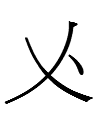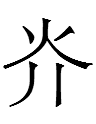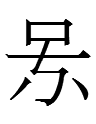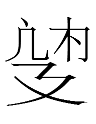
13.3.9.23:23: GONE, GENÚN, ΓUNIΓ
I am still stunned by the passing of Toren Smith, the man who opened doors for me in the manga industry - and who made that industry possible in the United States.
The Khitan word
<g.en.ún> 'sad'
from the Eulogy for 宣懿皇后 Empress Xuanyi in the small script came to mind.
I wonder what the large script spelling of genún was. Could it have been something like
<g.en.ün>?
And I wonder how the frontness (?) of genún can be reconciled with the backness of Written Mongolian cognate ɣuniɣ, a cognate suggested in Kane (2009: 114)
genún has
front (i.e., velar) g
front e
ú which might have been front [y]
(though Kane [2009: 30] pointed out that -ún appeared in words of both the [back?] a-group and [front?] e-group; could it have been a neutral central vowel [ʉ]?)
ɣuniɣ has
ɣ (i.e., back g; uvular despite its conventional notation; see Poppe's grammar)
back u
front yet neutral i < central *ɨ < back *ɯ?
Both words might descend from a Pre-Proto-Mongolic* root *g-n; Khitan -ún and Written Mongolian -iɣ cannot be reconciled and must be unrelated suffixes. I have no idea what the vowel of *g-n was. If it were, say, *ö, a vowel that was mid and front like Khitan e but rounded like Mongolian u, I would expect it to remain as ö in Written Mongolian.
*Pre-Proto- rather than simply Proto-Mongolic because Khitan is Para-Mongolic:
| Pre-Proto-Mongolic | |
| Para-Mongolic (extinct) | Proto-Mongolic |
| Khitan (extinct) | Mongolic languages proper |
'Para-Mongolic' means 'sister of Mongolic', so there could have been more than one Para-Mongolic branch, and there might not have been a single 'Proto-Para-Mongolic' language that was ancestral to two or more of those branches.